


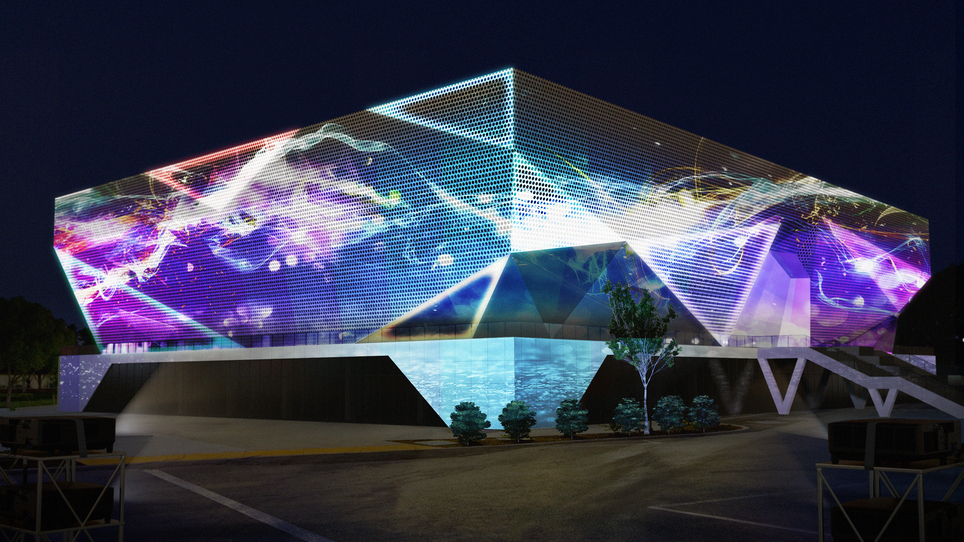
Visitors to museum galleries can now walk through projected historical scenes. Festival stages can be wrapped in synchronized visuals that delight audiences. Retail stores can produce stunning room-size projections that change with new collections.
The technology behind the shift? Laser projection. And recent advances in brightness, color, and long-term reliability have helped make large-scale immersive visuals far more practical than they were even five years ago.
Audiences are lapping this up, as more consumers turn to experiences over material goods. Almost two in three people now seek “moments of joy and excitement.”[1] Live and local experiences were the go-to entertainment purchase for 46% and 48% of people respectively in 2024, with 21% expecting to increase their spending on these in 2025.[2]
Venues, event producers, and brands are investing accordingly. The immersive entertainment sector is set to grow from $114 billion in 2024 to $442 billion by 2030.[3]
Several technical advances in digital projection technology have converged to make this growth possible:
Brightness
Laser projectors deliver intense output that holds up in challenging conditions, including ambient light, outdoor environments, and projection onto massive surfaces. That helps to make immersive experiences shine when mapping projections onto building facades or theme park attractions.
Color accuracy
Epson’s 3LCD technology splits light into red, green, and blue channels, dedicating a panel to each. That creates a wide color gamut to render visuals exactly as content creators intended. Accurate color is the difference between a flat image and one that produces a genuine emotional response.
Contrast and depth
Deeper blacks and brighter whites produce a high dynamic range to give images more depth. This helps to create more eye-catching projected environments that hold the audience’s attention.
Consistent experiences
Laser light is the key to stable brightness and color. It lasts for the projector’s entire lifespan without the gradual dimming or color drift you often get with a bulb. This consistency is crucial for permanent installations running daily. It means that audiences on day one and day one thousand see virtually the same thing.
Projection mapping
One of the biggest advances in projector technology has been projection mapping. Projectors can now wrap imagery around irregular surfaces, from curved walls and building facades to sculptural objects, rather than requiring a flat screen. This brings those surfaces alive.

Applications from theme parks to theaters
These technical developments have broadened the immersive applications for projectors. Theme parks use projection mapping for entertaining audiences during line-ups, enhancing rides, and architectural displays that transform facades after dark.
Museums like the Museum of Art + Light in Manhattan, Kansas create immersive historical recreations and digital art installations that put visitors inside the narrative rather than in front of it. Live events such as concerts, theater presentations, and corporate launches rely on projection for stage visuals and audience-wide effects. Many of those effects would be difficult to create with physical sets alone.
Laser projectors create even more immersive possibilities when married with other equipment to make the imagery interactive. For example, motion sensors might allow people to trigger different visuals and changes in musical tracks as they walk through an environment.
The Epson advantage
Epson laser projectors are well suited to this work. Three-chip 3LCD architecture delivers color brightness that matches white brightness with no rainbow artifacts or compromises in saturated tones. Units are compact and lightweight relative to their output, which simplifies transport and installation in unconventional spaces.
Epson offers the optional PixAlign camera for complex multi-projector setups. This supporting camera automates edge blending and geometric alignment for sharp, accurate installations. Epson’s Projector Professional tool also lets operators control networked units from a single interface. Setup that once took days can now happen in hours.
As audiences continue seeking richer sensory experiences, the equipment to deliver them has become more capable and more accessible. The gap between imagination and execution keeps narrowing.
Learn more about the next generation of 4K high-brightness projectors at Epson.com/LargeVenue
[1] “EY survey: Amid global uncertainty, consumers are seeking local and live entertainment experiences — but tech remains a key enabler”. April 2025, https://www.ey.com/en_gl/newsroom/2025/05/ey-survey-amid-global-uncertainty-consumers-are-seeking-local-and-live-entertainment-experiences-but-tech-remains-a-key-enabler
[2] “EY survey: Amid global uncertainty, consumers are seeking local and live entertainment experiences — but tech remains a key enabler”. April 2025, https://www.ey.com/en_gl/newsroom/2025/05/ey-survey-amid-global-uncertainty-consumers-are-seeking-local-and-live-entertainment-experiences-but-tech-remains-a-key-enabler
[3] “Immersive Entertainment Market Size | Industry Report, 2030.” Grand View Research, www.grandviewresearch.com/industry-analysis/immersive-entertainment-market-report


